.avif)


Why experiential businesses need more than contacts, pipelines, and spreadsheets
7-minute read
Key facts at a glance
- Experiential businesses manage people, visits, and sales across time, not just transactions.
- Traditional CRMs and Excel were built for reporting and pipelines, not lived customer journeys.
- An experience CRM connects visits, preferences, and purchases into a single, evolving customer view.
- Vintrail is built for wine, food, and tourism businesses where experiences and product sales reinforce each other.
The problem with calling everything a CRM
CRM, for Customer Relationship Management, has become a catch-all term. What once meant managing customer relationships is now used for everything from email tools to simple contact lists.
For wineries and experiential businesses, this confusion shows up every day. Visits, tastings, wine sales, memberships, and follow-ups are often managed across disconnected systems that were never designed to work together.
This dilution is more than semantic. It is structural.
A traditional retail CRM answers questions like:
Who bought what? When did they buy it? How much did they spend?
But many businesses today operate very differently.
They also need to know:
Who visited? Why did they come? What did they experience? What did they taste, learn, or discover? What made them return, buy again, or recommend the brand?
Most CRMs were never designed to hold those answers in the same place.
Excel is not a CRM. It is not even close.
Excel is powerful, flexible, and familiar. That is precisely why it overstays its welcome.
Spreadsheets are excellent for:
- Financial modeling
- Static reporting
- One off analysis
They are terrible at:
- Capturing live customer interactions
- Syncing bookings with people
- Preserving historical context
- Powering automation without human error
- Scaling across teams and seasons
More importantly, Excel does not remember. People do. And people leave.
When a business relies on spreadsheets to manage customers, visits, or sales history, it is effectively outsourcing its memory to whoever last updated the file. That is not customer relationship management. That is institutional amnesia.
Management research has long highlighted how spreadsheet driven operations tend to become single points of failure rather than systems of intelligence, a concern regularly raised in publications like Harvard Business Review.
Experiences are not transactions, but they drive transactions
This is the core misunderstanding.
When someone books a tasting, a tour, or a food experience, they are not buying a SKU. They are committing time, expectation, curiosity, and often emotion.
Pine and Gilmore described this shift as early as 1999 in The Experience Economy. Experiences are memorable by design, not by accident.
Yet the story does not end when the visit ends.
A well designed experience is often the starting point for something very concrete: future purchases, wine club memberships, repeat orders, and long term customer value.
Retail CRMs tend to separate experience from commerce. One tool for visits. Another for sales. Another for marketing.
Experience CRMs connect them.
They recognize that experiences and products are not opposing models. They are sequential. The experience creates trust. Trust drives sales. Sales reinforce the relationship.
That difference matters.

What defines a true experience CRM in 2026
By 2026, an experience CRM is not optional infrastructure. It is the operating system of the business.
A true experience CRM must do six things exceptionally well.
1. Connect people to moments and purchases
An experience CRM links a person to:
- Bookings and visits
- Tastings attended
- Guides or hosts encountered
- Wines tasted or products discovered
- Purchases made on site or after the visit
- Preferences expressed verbally, not just clicked
This creates a living narrative that connects experience and commerce, not a disconnected receipt history.
Research on personalization consistently shows that when context is preserved across touchpoints, customer satisfaction and revenue increase together, a dynamic highlighted by firms such as McKinsey.
2. Treat time as a core dimension
Experiences unfold across time. Before the visit. During the visit. After the visit.
A modern CRM must orchestrate:
- Pre visit communication
- On site recognition and service
- Post visit follow up
- Ongoing sales and relationship building
Retail CRMs often stop at conversion. Experience CRMs extend the relationship.
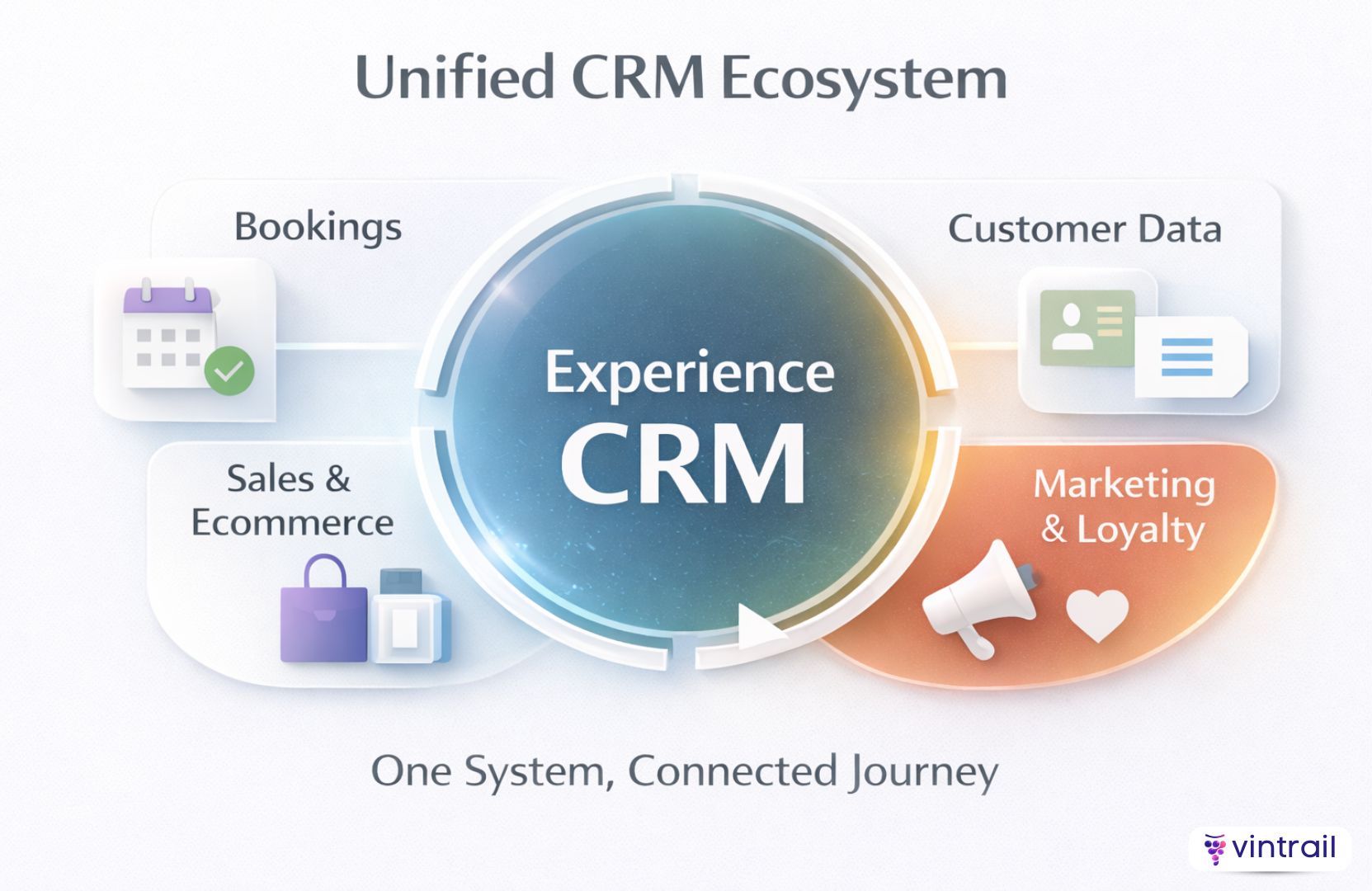
3. Unify bookings, CRM, and commerce
Fragmentation is the silent killer of both guest experience and sales performance.
When booking systems, ecommerce tools, POS, and CRM live in separate silos, teams improvise. Guests feel it immediately.
Industry research in tourism and hospitality has consistently shown that fragmented systems correlate with lower guest satisfaction and operational strain.
A modern experience CRM unifies these layers into one source of truth, allowing experiences and sales to reinforce each other rather than compete.
4. Preserve human nuance, not just data points
Not everything important fits neatly into a dropdown.
A good experience CRM allows teams to capture:
- Preferences shared in conversation
- Special occasions
- Cultural context
- Emotional signals
This is not about surveillance. It is about care, continuity, and relevance.
5. Enable segmentation that reflects real behavior
Experience based segmentation looks different.
It groups people by:
- Frequency of visits
- Type of experience preferred
- Products purchased over time
- Conversion from visitor to buyer
- Conversion from buyer to advocate
This is how wine clubs grow sustainably. This is how repeat sales happen naturally, without aggressive marketing.
6. Be designed for the people who actually use it
Perhaps the most overlooked requirement.
If the CRM feels like a corporate reporting tool, teams will resist it. Adoption will suffer. Data quality will decay.
An experience CRM must feel intuitive to hosts, guides, sales teams, and managers alike.
Usability has consistently been identified as a primary driver of CRM success or failure by analysts such as Gartner.
Why experiential businesses outgrow retail CRMs
Retail CRMs are optimized for scale and repetition. Experiential businesses are optimized for depth, differentiation, and relationship quality.
A winery does not want more anonymous customers. It wants fewer, stronger relationships that lead to long term sales.
A tasting room does not need aggressive funnel logic. It needs memory, recognition, and continuity.
This is why many businesses end up with fragmented stacks: bookings in one tool, sales in another, customer notes in spreadsheets.
The cost is often invisible at first.
Then it shows up as lost context, missed sales opportunities, inconsistent guest experiences, and team fatigue.
Where Vintrail fits in this evolution
Vintrail was built around this reality.
It is an experience native CRM, but it is also a full CRM for sales, customer data, and long term relationship management.
Its strength lies in connecting visits, experiences, and product sales into a single, intuitive system.
Every customer profile evolves over time. Every visit adds context. Every purchase strengthens the relationship.
This allows businesses to move from reactive operations to intentional experience and sales design, without multiplying tools.
You can explore how Vintrail approaches CRM for experiential and sales driven businesses by booking a demo.
The strategic shift for 2026
The question for modern businesses is no longer whether they need a CRM.
The question is whether their CRM understands how experiences and sales actually work together.
If your product is a moment, your system must remember moments.
If your revenue depends on repeat purchases, your system must connect those moments to sales.
If your growth depends on loyalty, your tools must be built for relationships, not rows.
Excel cannot do that. Retail CRMs were never meant to.
Experience CRMs are not a trend. They are a correction.
And in 2026, they will be the difference between businesses people visit once and businesses they return to, buy from, and advocate for.