.avif)


Online Travel Agencies (OTAs) have become an increasingly important part of the wine tourism landscape. Platforms such as GetYourGuide, Viator, and others influence how travelers discover and book experiences—often before they even arrive in a wine region.
For wineries, this raises an important question:
How do OTAs fit into a sustainable wine tourism strategy?
This guide explains what OTAs are, how wineries typically use them, and how platforms like Vintrail help wineries approach OTA distribution with clarity and operational control—without sacrificing profitability or brand identity.
What Are OTAs, and Why Do Wineries Use Them?
OTAs (Online Travel Agencies) are platforms that market and sell experiences to travelers, including tours, tastings, and activities.
In wine tourism, OTAs primarily serve one role:
Discovery
They help wineries:
- Reach international travelers who may not yet know which wineries to visit
- Increase visibility during peak travel seasons
- Capture demand during shoulder or lower-demand periods
- Access audiences already searching for experiences and activities
Importantly, OTAs are distribution channels, not competitors.
When used intentionally, they complement direct bookings rather than replace them.
For many wineries, OTAs function as a customer acquisition channel—bringing new visitors into the winery ecosystem.
Understanding the Cost Structure of OTAs
One of the most common concerns wineries have about OTAs is cost—and that concern is valid.
While exact terms vary depending on the platform, region, and commercial agreement, OTAs for tours and activities commonly charge:
- Commission on each booking, often around 20–30%
- Operational or payment-related fees in some cases
- Optional promotional visibility programs depending on the platform
At first glance, these percentages can seem high.
However, the key question is not simply:
“Are OTAs expensive?”
The more important question is:
“How do we use OTAs in a way that still makes business sense?”
Successful wineries evaluate OTAs based on:
- Incremental visitor acquisition
- On-site wine sales
- Customer lifetime value
- International visibility
- Long-term direct sales opportunities
In many cases, the value of a new qualified visitor extends far beyond the initial tasting reservation.
To support OTA connectivity and booking automation, wineries also typically rely on technology infrastructure that synchronizes availability, centralizes reservations, and reduces operational complexity across multiple sales channels.
At Vintrail, this infrastructure is designed to simplify OTA distribution while helping wineries maintain operational control and ownership of the customer relationship.
Where Wineries Actually Create Profit
A key concept in wine tourism is understanding where profitability is really generated.
For many wineries:
- Tastings and tours are entry points
- Profit is often created during and after the visit
This includes:
- Bottle purchases during the experience
- Premium tasting upgrades
- Wine club memberships
- Repeat online orders
- Long-term direct customer relationships
In other words:
The tasting itself is often not the final product—it is the beginning of the customer relationship.
This is where a strong direct-to-consumer (DTC) strategy becomes essential.
The wineries that perform best with OTAs are typically those that successfully convert visitors into long-term customers through:
- CRM and customer segmentation
- Email marketing
- Wine clubs
- Rebooking strategies
- E-commerce and post-visit sales
OTAs can be highly effective when they bring the right guests—those who engage with the winery beyond a single booking.
Common Pricing Approaches Wineries Use with OTAs
There is no universal OTA pricing strategy.
Most wineries begin with a relatively simple structure and refine it over time based on performance, margins, and operational realities.
At a high level, three approaches are commonly used:
1. Same Price Everywhere (Price Parity)
The same public price is offered on both the winery website and OTAs.
This approach is:
- Simple to manage
- Clear for customers
- Operationally straightforward
Many wineries choose this model when:
- On-site wine sales are strong
- OTAs are viewed primarily as a marketing and acquisition channel
- Simplicity and consistency are prioritized
At the same time, wineries still need to account for OTA-related costs within their broader margin strategy.
2. Different Offers for OTAs
Some wineries create differentiated OTA offers by:
- Adjusting pricing slightly
- Bundling experiences differently
- Creating alternative package structures
- Using different naming or positioning
3. OTAs as an Entry-Level Discovery Channel
Some wineries use OTAs primarily for:
- Entry-level tastings
- Discovery-focused experiences
- Introductory wine tourism offers
Meanwhile:
- Premium tastings
- Private experiences
- Collector events
- High-margin offerings
are reserved for direct bookings.
This allows wineries to maximize visibility while protecting premium positioning and margins.
Most wineries start with one approach, then evolve as they gain more operational data and customer insights.
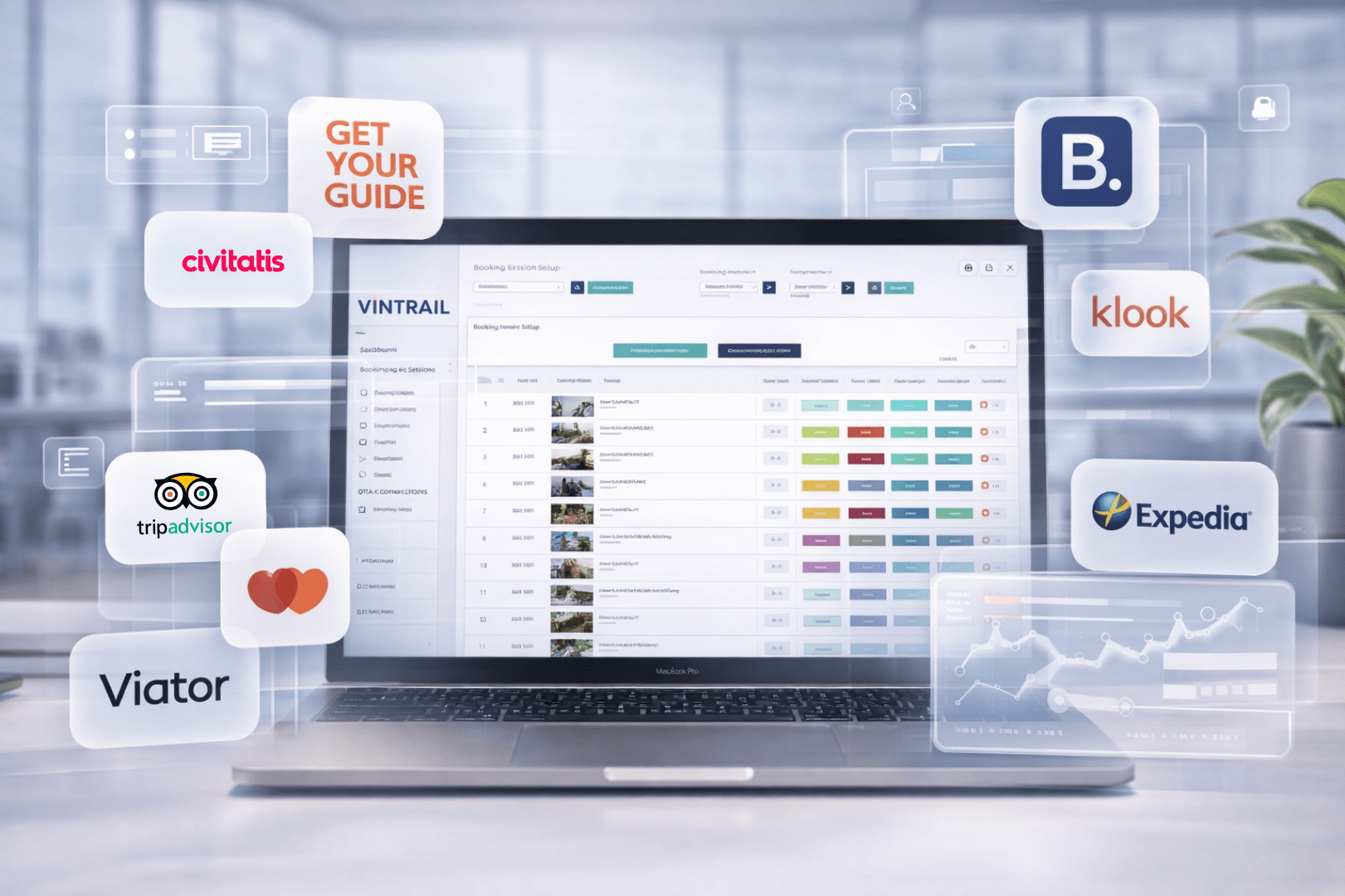
The Role of Channel Management in OTA Distribution
Managing OTAs manually quickly becomes operationally difficult.
Wineries often face:
- Multiple calendars
- Multiple extranets
- Availability inconsistencies
- Manual updates
- Increased overbooking risk
This is where channel management becomes critical.
A channel manager allows wineries to:
- Centralize availability
- Synchronize bookings automatically
- Reduce manual workload
- Maintain consistency across platforms
- Improve operational efficiency
At Vintrail, OTA connectivity is designed to support wineries with:
- Secure synchronization
- Centralized availability management
- Simplified booking operations
- Integrated reservation workflows
Importantly, wineries retain control over:
- Pricing
- Experience design
- Availability rules
- Customer strategy
- Brand positioning
The objective is not simply to “be on OTAs.”
It is to use distribution strategically while maintaining direct ownership of the customer relationship.
Setting Up Experiences for Better OTA Performance
Regardless of platform, successful OTA listings tend to share several common characteristics.
Three elements consistently improve visibility and conversion performance:
1. Strong Visuals
High-quality imagery plays a major role in traveler decision-making.
Clear and inviting visuals help potential guests quickly understand:
- The atmosphere
- The setting
- The quality of the experience
Strong photography increases trust and booking confidence.
2. Clear Experience Descriptions
Guests should immediately understand:
- What the experience includes
- How long it lasts
- What makes it unique
- Who it is designed for
Clarity reduces friction and improves conversion rates.
3. Flexible Availability
More flexibility often improves OTA visibility and booking performance.
This may include:
- Multiple time slots
- Multi-language experiences
- Seasonal adjustments
- Dynamic capacity management
Digital booking infrastructure makes this flexibility easier to manage without creating operational strain.
A Simple Decision Check Before Using OTAs
Before investing in OTA distribution, wineries should evaluate a few practical questions:
- Do we generate meaningful on-site wine sales per visitor?
- Will OTAs create incremental demand rather than simply replace direct bookings?
- Are we comfortable with a simple initial pricing strategy?
- Do we have seasonality or demand gaps OTAs could help fill?
- Do we have systems to convert visitors into long-term direct customers?
- Can we review performance and adjust after the first 30–60 days?
There is no universal OTA model.
The right strategy depends on each winery’s positioning, margins, operational structure, and long-term goals.
Final Thoughts
OTAs are tools.
Used strategically, they can:
- Increase visibility
- Expand international reach
- Support wine tourism growth
- Complement direct booking channels
- Generate new customer acquisition opportunities
The key is intentional use.
The wineries that benefit most from OTAs are usually those that combine visibility with:
- Strong direct booking infrastructure
- CRM and customer retention
- Clear pricing logic
- Efficient operational management
- Long-term DTC strategy
At Vintrail, we help wineries approach OTA distribution with structure, operational clarity, and centralized control—while keeping ownership of the customer relationship at the center of the strategy.