.avif)

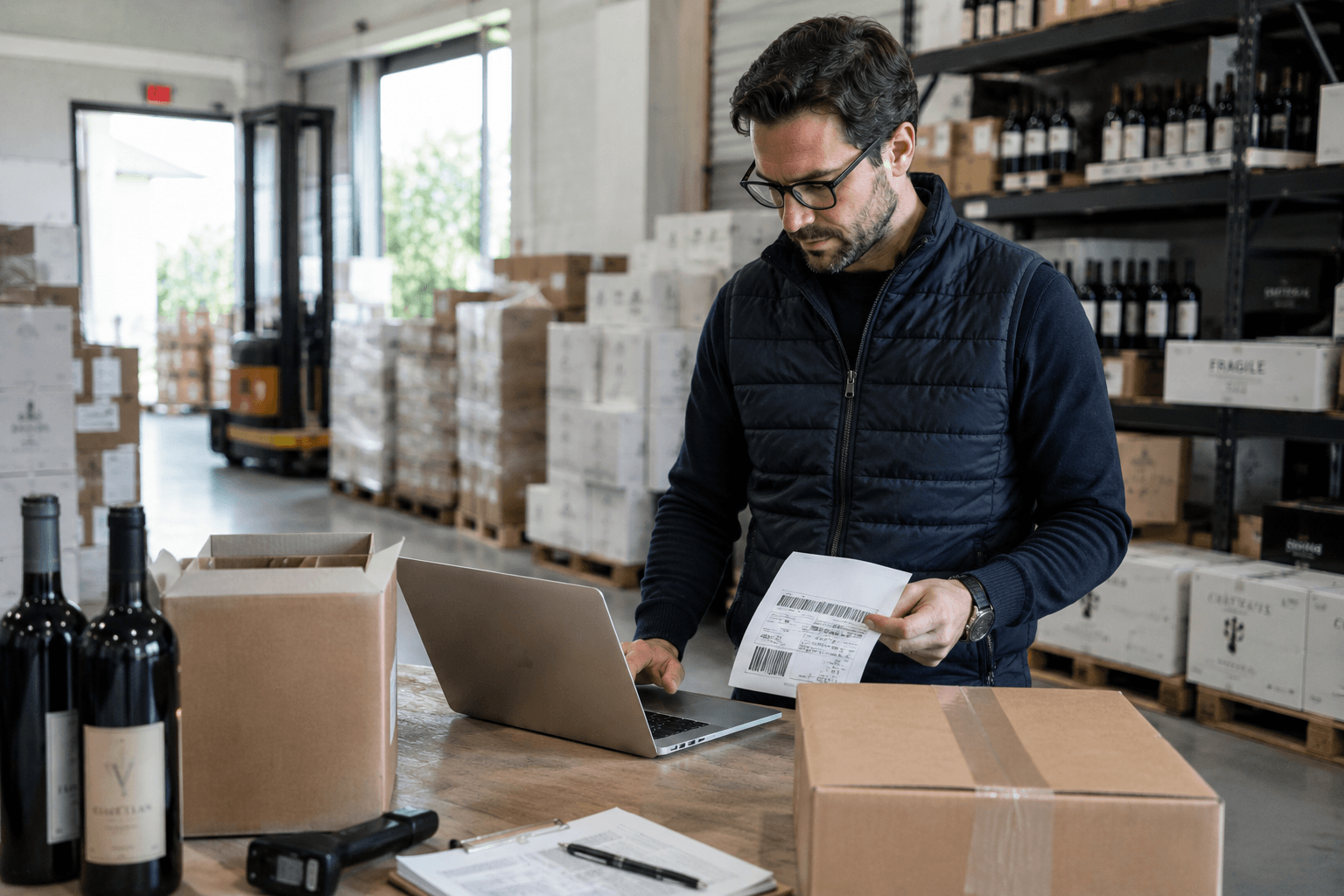
Direct-to-consumer wine sales have created significant opportunities for wineries: closer customer relationships, stronger margins, greater loyalty and less dependence on traditional distribution.
But growth introduces a challenge that is far less visible from the outside.
Logistics.
Shipping a few orders each week may be perfectly manageable. A team member prepares the labels, someone checks the destination requirements, and orders are coordinated through spreadsheets, emails or separate platforms.
Then volumes rise.
The same process that worked for ten shipments begins to strain at fifty. During a wine club release, tourism peak or holiday campaign, it can become a bottleneck.
At that point, logistics is no longer simply a back-office task. It is part of the customer experience and, increasingly, part of the winery’s capacity to grow.
Wine Shipping Is Not Standard Ecommerce
Every wine shipment can involve a different combination of requirements:
- alcohol regulations
- destination restrictions
- taxes and duties
- carrier limitations
- customs documentation
- suitable packaging
- temperature conditions
- delivery coordination
- age verification or signature requirements
The complexity increases when a winery begins selling across several regions or internationally.
Order volume is only part of the equation. More shipments also generate more tracking enquiries, documentation, exceptions, delivery changes and customer communication.
No single task necessarily feels unmanageable. The problem is their accumulation across hundreds or thousands of orders.
That is how operational friction takes hold: gradually, quietly and often before the winery recognises it as a growth constraint.
The Customer Experience Does Not End at Checkout
Customers do not separate the wine from the experience of receiving it.
Unexpected shipping costs, vague delivery times, missing updates or customs surprises all affect their perception of the winery itself.
This is particularly important for premium wines, international orders and limited allocations. The greater the value of the purchase, the less comfortable customers are with uncertainty.
Today’s ecommerce delivery expectations have also been shaped by experiences far beyond the wine industry. Customers increasingly expect:
- clear shipping costs
- realistic delivery estimates
- regular status updates
- proactive communication
- a straightforward delivery experience
Logistics is therefore more than operational infrastructure. It is a layer of customer trust.
Manual Fulfilment Works Until It Suddenly Doesn’t
At lower volumes, wineries can compensate for disconnected systems through individual effort.
Teams copy order details between platforms, check shipping requirements manually, prepare documents, email logistics partners and update customers one by one.
These workarounds often become established routines. Because the team knows how to make them work, the underlying inefficiency can remain hidden for a surprisingly long time.
The weakness becomes visible when demand peaks:
- seasonal releases
- tourism periods
- wine club shipments
- international campaigns
- holiday gifting
- event-driven sales
These are precisely the moments when a winery should be able to benefit from increased demand. Instead, the team may spend its time correcting data, answering delivery questions and coordinating exceptions.
Growth has arrived, but the operation is not ready to absorb it.
Visibility Reduces Pressure on Both Sides
Once an order has left the winery, customers primarily want reassurance.
Has it shipped? Where is it now? Is someone required to sign for it? Are duties included? When should it arrive?
When shipment information is fragmented across carriers, emails and internal files, every question becomes another manual task for the winery.
Centralised status visibility and automatic notifications reduce that uncertainty. Customers know what is happening, while the team handles fewer repetitive enquiries and can identify exceptions sooner.
Good delivery communication will not eliminate every delay or customs issue. It does, however, prevent uncertainty from becoming frustration.
That distinction matters. Customers are often more understanding of a delay when it is communicated clearly than of silence when they do not know what has happened.
Connected Logistics Removes the Human Integration Layer
The purpose of connected logistics is not simply to make individual shipping tasks faster. It is to stop people from having to hold the entire process together manually.
When sales, customer information, fulfilment and shipment statuses remain disconnected:
- information is entered more than once
- processes depend on individual memory
- teams lose visibility
- customer communication becomes inconsistent
- exceptions take longer to resolve
In effect, employees become the integration layer between the winery’s systems.
Connected infrastructure changes that. Orders can move from sale to fulfilment with fewer manual handovers. Documentation and labels can be generated through integrated logistics partners. Shipment statuses remain visible, and customers can receive updates as their orders progress.
The result is not just faster shipping. It is a more predictable operation.
Wine Commerce Now Spans Multiple Customer Journeys
A customer might discover a winery through a tourism marketplace, make a booking, purchase wine through the POS, join a wine club and later reorder online.
To the customer, these are not separate channels. They are different moments in one relationship with the winery.
The winery’s systems should reflect that continuity.
This is how we approach logistics at Vintrail Pro: not as an isolated shipping tool, but as part of a connected sales ecosystem spanning reservations, CRM, ecommerce, POS, wine clubs, fulfilment and customer communication.
Because the real logistics challenge is not simply sending more boxes.
It is making sure that every new sale can move smoothly through the business without creating disproportionate work behind the scenes.
When logistics is connected, growth remains an opportunity.
When it is not, growth can quickly become the problem.