.avif)

Your customer has chosen their wines, paid for their order and received a shipping confirmation.
As far as they are concerned, the purchase is complete.
Then another payment request arrives.
Customs duties. Import taxes. Clearance fees. Costs they had not anticipated, for wine they thought they had already paid to receive.
For wineries developing international direct-to-consumer sales, this is where a shipping decision becomes a customer relationship issue.
Two terms help explain the difference: DAP and DDP.
What Is the Difference Between DAP and DDP?
DAP and DDP are international commercial terms that allocate responsibilities between seller and buyer.
With DAP (Delivered at Place), the seller arranges transport to the agreed destination, while the buyer takes responsibility for import clearance and its associated charges.
With DDP (Delivered Duty Paid), the seller also takes responsibility for import clearance and the applicable duties and taxes. The ICC Academy explains this distinction.
For the customer, the practical difference is whether import charges are covered by the purchase or need to be settled separately.
Delivery included does not necessarily mean import charges included.
Why Can DAP Make an Order Look Cheaper?
Because the amount collected at checkout may cover the wine and transport without including the charges due when the shipment enters the destination country.
The initial total looks lower. The final cost may not be.
DAP can be appropriate when buyers understand and accept their import responsibilities. The difficulty arises when a consumer interprets “shipping included” as “nothing more to pay.”
A note buried in the delivery terms does little to prevent that misunderstanding.
What Does This Look Like in Practice?
Consider an illustrative order of twelve bottles shipped internationally.
These figures demonstrate the payment flow only. They are not a shipping quote or a tax calculation for a particular destination.
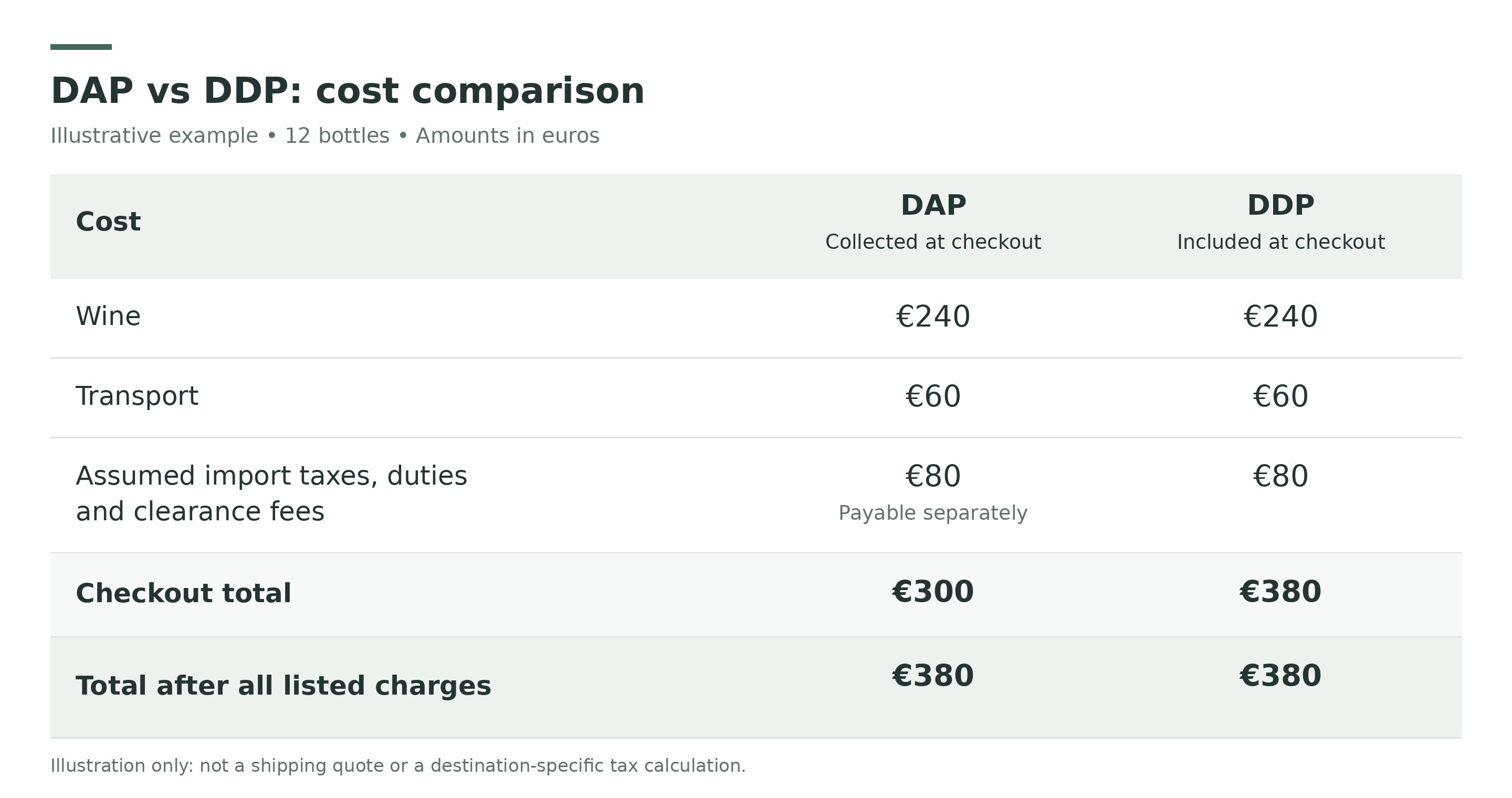
In this example, the DAP order initially appears €80 cheaper.
But the customer ultimately pays the same amount. What changes is when they discover the full cost and how it is collected.
With DAP, the additional request can interrupt the experience. The customer may question the bill, delay payment or refuse it.
With DDP and an accurate inclusive checkout price, the customer accepts the €380 total before buying. The winery accounts for those costs when pricing the order.
The advantage is predictability, rather than an automatic saving.
What Happens If the Customer Refuses to Pay?
Allocating import charges to the buyer does not necessarily protect the winery from the carrier’s claim.
FedEx states that it may advance duties and taxes and invoice the recipient. If the recipient refuses to pay, the shipper remains ultimately liable.
Applied to our example, the winery could face the €80 bill it had expected the customer to settle.
It then has an uncomfortable choice: seek reimbursement from the customer or absorb the expense.
Either outcome adds work after the sale. One risks a difficult customer conversation; the other reduces the margin on the order.
Carrier billing procedures vary, so wineries should check their own shipping agreements rather than assume DAP removes this exposure.
Does DDP Mean the Winery Must Absorb the Taxes?
No. Responsibility for settling import charges does not mean those costs must come out of the winery’s margin.
They can be incorporated into the price paid by the customer, as the example shows.
The important distinction is between collecting the full amount as part of the sale and requesting an additional payment afterwards. DHL identifies clearer upfront costs as a key advantage of DDP for ecommerce.
However, DDP alone does not calculate an accurate checkout total. The winery still needs reliable pricing, the correct shipment information and a suitable logistics arrangement.
Is DDP Suitable for Every Wine Shipment?
Availability depends on the destination, local import requirements and the arrangements the seller can put in place. As the ICC Academy notes, local rules can prevent a foreign seller from carrying out the import formalities required under DDP.
For eligible consumer shipments, DDP can support a clearer buying experience. Where DAP is used, any additional payment obligations should be made explicit before the customer orders.
The objective is the same: customers should understand the financial commitment they are making.
How Does Vintrail Pro Connect the Dots?
Transparent pricing needs to carry through from the sale to the shipment.
Vintrail Pro connects ecommerce, POS and wine club orders with specialist logistics partners. Its workflows include shipping costs and applicable duties and taxes in the payment collected by the winery, alongside connected documentation, tracking and customer notifications.
That gives teams a clearer process and customers a more consistent experience.
Explore Vintrail Pro’s logistics solution and book a demonstration to see how it can support your international wine sales.